




Money Fund Wisdom
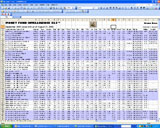
The January issue of our flagship Money Fund Intelligence newsletter, which was sent to subscribers Wednesday morning, features the articles: "Yields Bottoming Near 4.20%; Assets Keep Breaking Records," which discusses the move lower and plateauing of yields and jumps in assets; "ICI: Worldwide MMF Assets Rise in Q3'24 to $11.2 Tril.," which looks at the latest MMF statistics outside the U.S.; and, "Top Money Funds of 2024; 16th Annual MFI Awards" which reviews the best performing MMFs of 2024. We also sent out our MFI XLS spreadsheet Wednesday a.m., and we've updated our Money Fund Wisdom database with 12/31/24 data. Our Jan. Money Fund Portfolio Holdings are scheduled to ship on Friday, December 10, and our Jan. Bond Fund Intelligence is scheduled to go out on Wednesday, January 15.
MFI's "Yields Bottoming" article says, "Money fund yields fell by 16 basis points to 4.28% on average during December (down from 5.20% at the start of 2024). Our Crane 100 Money Fund Index continues inching lower, falling to 4.23% as of 1/6/25. Fund yields have now digested most of the Federal Reserve's 25 basis point cut on Dec. 18, though they may inch a lower in coming days. But yields should remain solidly above 4.0% in the near-term, and they may even hold these levels for the entire year as expectations for more rate cuts evaporate."
It continues, "Yields on average have declined by 81 bps since the Fed first cut its Fed funds target rate by 50 bps percent on Sept. 18, and they've declined by 38 bps since the Fed cut rates by 1/4 point on 11/7. Yields were 4.45% on 11/30/24, 4.65% on 10/31, 4.75% on 9/30, 5.10% on 8/31, 5.13% on 7/31 and 6/28, 5.14% on 3/31/24 and 5.20% on 12/31/23."
We write in our Worldwide article, "The Investment Company Institute published, 'Worldwide Regulated Open-Fund Assets and Flows, Third Quarter 2024,' which shows that money fund assets globally rose by $572.9 billion, or 5.4%, in Q3'24 to a record $11.215 trillion. Increases were led by a sharp jump in money funds in U.S., Ireland and China, while Luxembourg and France also rose. Meanwhile, money funds in Mexico and Korea were lower. MMF assets worldwide increased by $1.271 trillion, or 12.8%, in the 12 months through 9/30/24, and MMFs in the U.S. now represent 60.4% of worldwide assets."
It states, "ICI's release says, 'Worldwide regulated open-end fund assets increased 6.8% to $74.95 trillion at the end of the third quarter of 2024, excluding funds of funds. Worldwide net cash inflow to all funds was $913 billion in the third quarter, compared with $819 billion of net inflows in the second quarter of 2024. The Investment Company Institute compiles worldwide regulated open-end fund statistics on behalf of the International Investment Funds Association (IIFA), the organization of national fund associations. The collection for the third quarter of 2024 contains statistics from 44 jurisdictions.'"
Our "Top Money Funds of 2024" piece says, "This issue recognizes the top performing money funds, ranked by total returns, for calendar year 2024, as well as the top funds for the past 5‐year and 10‐year periods. We present the funds below with our annual Money Fund Intelligence Awards. These are given to the No. 1‐ranked funds based on 1‐year, 5‐year and 10‐year returns, through Dec. 31, 2023, in each of our major fund categories -- Prime Institutional, Government Institutional, Treasury Institutional, Prime Retail, Government Retail, Treasury Retail and Tax‐Exempt."
The piece continues, "The Top-Performing Prime Institutional fund (and fund overall) was BlackRock Cash Inst MMF SL (BISXX), which returned 5.43%. Among Prime Retail funds, Schwab Value Adv MF Ultra (SNAXX) had the best return in 2024 (5.36%). (Our Crane 100 Money Fund Index returned 5.08% in 2024.)"
MFI also includes the News brief, "Fed Cuts Rates Another 1/4 to 4.375%. The FOMC's Statement says, 'Inflation has made progress toward the Committee’s 2 percent objective but remains somewhat elevated.... In support of its goals, the Committee decided to lower the target range for the federal funds rate by 1/4 percentage point to 4-1/4 to 4-1/2 percent.'"
Another News brief, "J.P. Morgan's 'Mid-Week US Short Duration Update,' features, 'November MMF Holdings Update: Sufficient Supply Meeting MMFs' Demand.' It states, 'Taxable MMFs experienced another strong month of inflows in November, with AUMs increasing by nearly $200bn, bringing total balances to just under $7tn. Despite this significant rise in balances, MMFs successfully found enough supply to meet their demand throughout the month, aided by a rise in T-bill, repo, and time deposit outstandings. As a result, MMFs' use of ON RRP fell to an end-of-month low since May 2021.'"
A third News brief, "SEC Stats: MMF Assets Jump to Record $7.13 Tril. in Nov., Yields Fall," says, "The SEC's 'Money Market Fund Statistics' show that total money fund assets rose by $197.8 billion in November to a record $7.125 trillion. Prime MMFs increased $12.9 billion to $1.187 trillion, Govt & Treasury funds increased $181.5 billion to $5.797 trillion and Tax Exempt funds increased $3.4 billion to $141.3 billion. Taxable yields fell again in November after plunging in October.'"
A sidebar, "WSJ on Why to Cheer MMFs," says, "The Wall Street Journal tells us, 'Why You May Want to Cheer for Money-Market Funds.' Subtitled, 'Money funds remain an attractive place for excess cash and can help keep a lid on short-term borrowing costs,' the article says, 'Cash might be a trash asset to some risk-loving traders. But it's a pretty good thing to have sloshing around the economy. U.S. money-market fund assets have so far through mid-December grown by over $800 billion in 2024, bringing the nearly two-year gain since the end of 2022 to roughly $2 trillion, according to [ICI]. This continuing flow may be a surprise to some. At points in 2024, it often seemed that Fed ... cuts, plus a bullish tilt to equity markets, would push more investors out of cash.'"
Our January MFI XLS, with Dec. 31 data, shows total assets increased $113.0 billion to a record $7.184 trillion, after increasing $196.1 billion in November, $89.9 billion in October, $155.2 billion in September, $105.6 billion in August, $19.7 billion in July, $11.8 billion in June and $79.7 billion in May. They decreased $17.6 billion in April and $66.7 billion in March, but increased $50.0 billion in February and $87.0 billion last January.
Our broad Crane Money Fund Average 7-Day Yield was down 15 bps at 4.19%, and our Crane 100 Money Fund Index (the 100 largest taxable funds) was also down 16 bps at 4.28% in December. On a Gross Yield Basis (7-Day) (before expenses are taken out), the Crane MFA and the Crane 100 averaged 4.58% and 4.55%. Charged Expenses averaged 0.39% and 0.27% for the Crane MFA and the Crane 100. (We'll revise expenses once we upload the SEC's Form N-MFP data for 12/31/24 on Thursday, 1/9.) The average WAM (weighted average maturity) for the Crane MFA was 37 days (up 1 bp) and the Crane 100 WAM was unchanged from the previous month at 37 days. (See our Crane Index or craneindexes.xlsx history file for more on our averages.)
Issues
Latest Contents ()
The content page contains archives and delivery settings for all subscriptions.
| Product Summary | ||
|---|---|---|
| Price | $4000/yr | ( Discount Policy ) |
| News |

|
( Research ) |
| Ranks |
|
( Custom ) |
| Funds |
|
( Full Database ) |
| Archives |
|
( Research ) |
| Index |
|
( Custom ) |
| Next Steps | ||
| Subscribe Now » | ||
| See a demo issue. | ||
| Call 1-508-439-4419 for order or info. | ||
Money Fund Wisdom News
Jun 06
The June issue of our flagship Money Fund Intelligence newsletter, which was sent to subscribers Friday morning, features the articles: "Shift from Treasuries to Repo Continues; FICC Repo Hits $1T," which discusses recent portfolio composition shifts in the MMF space; "Fed, EU Focus on Treasuries, Money Markets, NBFIs," which looks at bank regulators renewed interest in MMFs and non-banks; and, "Fitch: Liquidity LGIPs Rise to Over $430B; S&P Q1 Update" which reviews recent news on local government investment pools. We also sent out our MFI XLS spreadsheet Friday a.m., and we've updated our Money Fund Wisdom database with 5/31/25 data. Our June Money Fund Portfolio Holdings are scheduled to ship on Tuesday, June 10, and our June Bond Fund Intelligence is scheduled to go out on Friday, June 13. (Note: Register ASAP for our upcoming Crane's Money Fund Symposium, which is in just over 2 weeks -- June 23-25 -- in Boston!)
MFI's "Shift from Treasuries" article says, "The U.S. Treasury's Office of Financial Research (OFR) published a blog piece titled, 'OFR's MMF Monitor Shows Reduced Federal Reserve ON RRP Use.' It states, 'In Q1 2025, U.S. money market funds (MMFs) experienced strong cash inflows from retail and institutional investors that pushed assets to $7.4 trillion by quarter-end, according to OFR's U.S. Money Market Fund Monitor data. Investors sought relative safety from broader market volatility and benefited from the yield advantage generally offered by MMFs over alternative investment products.'"
It continues, "They write, 'MMFs also lowered their exposure to U.S. Treasury securities and increased their repurchase agreement (repo) allocation to over $2.8 trillion.... The change primarily reflected high repo rates and a net decrease in U.S. Treasury issuance. The U.S. Department of the Treasury is conserving its borrowing authority until the federal debt limit is raised or suspended.'"
We write in our "Fed, EU Focus article, "After a period of silence, bank regulators appear to be focusing once more upon money market funds and other non-bank players in the financial markets. Federal Reserve Bank of Dallas President Lorie Logan recently hosted a panel on 'The Increasing Role of Nonbank Institutions in the Treasury and Money Markets' at the Federal Reserve Bank of Atlanta 2025 Financial Markets Conference. The panel featured Lou Crandall of Wrightson ICAP, Deirdre Dunn of Citigroup Global Markets and chair of the Treasury Borrowing Advisory Committee, and Nate Wuerffel of BNY."
It states, "Logan comments, 'Our topic this afternoon is a timely one: the role of nonbank financial institutions (NBFIs) in Treasury and money markets.... The Treasury market and money markets sit at the very core of the financial system. The Treasury market finances the U.S. government, provides a safe and liquid asset relied on by investors worldwide, and creates a benchmark for broader long-term interest rates. Money markets establish overnight risk-free interest rates that are building blocks for all other asset prices, they keep credit flowing through the economy by financing a wide range of assets, and they are where the Fed implements the stance of monetary policy. And these markets are tightly linked because one of the main money markets is the repo market, where Treasury securities are financed.'"
Our "LGIP" piece says, "Fitch Ratings published 'U.S. Local Government Investment Pools Monitor: 1Q25,' which states, 'Fitch Ratings' two local government investment pool (LGIP) indices reported an aggregate asset increase in the first quarter of 2025 (1Q25) driven by Liquidity LGIPs, consistent with seasonal flow trends. Total assets for the Fitch Liquidity LGIP Index and the Fitch Short-Term LGIP Index reached $655.5 billion at quarter end, marking increases of $9.3 billion qoq and $40.5 billion yoy.' (Fitch's tables shows the Liquidity LGIP total at just $430.7 billion and the Short-Term LGIP total at $224.8 billion.)"
The article continues, "It says, 'The Fitch Liquidity LGIP Index rose by 2.3% qoq while the Fitch Short-Term LGIP Index fell by 0.2% qoq. These changes contrast with an average increase of 6.2% and average decrease of 1.8%, respectively, during the first quarter over the past three years.'"
MFI also includes the News brief, "Assets Hit Record $7.4 Trillion." It states, "Our MFI Daily asset series hit a record $7.406 trillion on June 3 (then dipped 6/4). Our MFI XLS monthly series hit a record $7.408 trillion in May. ICI's smaller weekly series shows assets retaking $7.0 trillion in the latest week." (See today's Link of the Day.)
Another News brief, "SEC Webinar Cites Money Funds," says, "Former Director of the SEC's Division of Investment Management Joel Goldberg cited money funds' survival from regulatory extinction in the early 1970's as the most important development in fund regulations. Barry Barbash also reviewed money funds' troubles during the Great Financial Crisis, and the webinar discussed tokenized MMFs."
A third News brief titled, "Portfolio Holdings: FICC Repo Hits $1T, T-Bills Drop," tells us, "Our May Money Fund Portfolio Holdings, with data as of April 30, 2025, show that holdings of Repo jumped last month while Treasuries declined. Repo, now the largest segment, increased $31.4 billion in April. Treasuries, now the second largest portfolio composition segment, decreased by $168.3 billion. Agencies were the third largest segment, CP remained fourth, ahead of CDs, Other/Time Deposits and VRDNs."
A sidebar, "Stradley Reviews MMF Regs," says, "Stradley Ronon Partner Jamie Gershkow and Associate Geena Marzouca recently published, 'Are We Trying to Kill Institutional Prime Funds? -- Money Market Funds in a Post Reform Era.' It explains, 'At a meeting of the US Securities and Exchange Commission (SEC) adopting significant reforms to money market fund regulation, Commissioner Peirce posed a pointed question: Are we trying to kill institutional prime funds? [T]his article looks at whether Commissioner Peirce’s concern became reality and assesses the overall impact of the reforms on the money market fund industry. [It] reviews considerations related to the implementation of certain aspects of the reforms, including liquidity fees, share cancellation, increased liquidity requirements and stress testing, and board oversight of money funds under amended Rule 2a-7 of the Investment Company Act of 1940 (1940 Act).'"
Our June MFI XLS, with May 31 data, shows total assets jumped $90.3 billion to a record high $7.408 trillion, after decreasing $26.6 billion in April and $4.6 billion in March. Assets increased $90.4 billion in February, $47.9 billion in January and $113.0 billion in December. Assets jumped $196.1 billion in November, $89.9 billion in October, $155.2 billion in September, $105.6 billion in August, $19.7 billion in July and $11.8 billion last June.
Our broad Crane Money Fund Average 7-Day Yield was down 1 bp to 4.01%, and our Crane 100 Money Fund Index (the 100 largest taxable funds) was down 2 bps to 4.11% in May. On a Gross Yield Basis (7-Day) (before expenses are taken out), the Crane MFA and the Crane 100 averaged 4.38% and 4.38%. Charged Expenses averaged 0.37% and 0.27% for the Crane MFA and the Crane 100. (We'll revise expenses once we upload the SEC's Form N-MFP data for 5/31/25 on Monday, 6/9.) The average WAM (weighted average maturity) for the Crane MFA was 37 days (up 3 days) and the Crane 100 WAM was up 5 days from the previous month at 39 days. (See our Crane Index or craneindexes.xlsx history file for more on our averages.)
Apr 07
The April issue of our flagship Money Fund Intelligence newsletter, which was sent to subscribers Monday morning, features the articles: "Money Market ETFs Now a Thing: Schwab Joins BlackRock," which discusses the recent launches of and news in the MM ETF space; "Bond Fund Symposium '25 Focus on Ultra-Shorts, ETFs," which looks at our recent conference in Newport Beach; and, "Worldwide MMFs Rise in Q4 to Record $11.6 Tril.; US, Lux" which reviews ICI's Worldwide fund totals. We also sent out our MFI XLS spreadsheet Monday a.m., and we've updated our Money Fund Wisdom database with 3/31/24 data. Our April Money Fund Portfolio Holdings are scheduled to ship on Wednesday, April 9, and our April Bond Fund Intelligence is scheduled to go out on Monday, April 14.
MFI's "Money Market ETF" article says, "It looks like we'll soon have a fourth 'money market' ETF offering. A Form N-1A Registration filing for the Schwab Government Money Market ETF (SGVT) tells us, 'The fund intends to operate as a government money market fund under the regulations governing money market funds. The fund will invest at least 99.5% of its total assets in cash, government securities and/or repurchase agreements.'"
The filing explains, "Although the fund intends to operate as a 'government money market fund,' it will not seek to maintain a stable net asset value ('NAV') per share nor will it use amortized cost.... Instead, the fund will calculate its NAV ... based on the market value of its investments. In addition, unlike a traditional money fund, the fund operates as an exchange traded fund ('ETF'). As an ETF, the fund's shares will be traded on the [NYSE] exchange and will generally fluctuate in accordance with changes in NAV as well as the relative supply of, and demand for, shares on the [NYSE]. You could lose money by investing."
We write in our BFS '25 article, "Crane Data recently hosted its latest Bond Fund Symposium in Newport Beach, Calif. The keynote talk, 'Ultra‐Short Bond Funds: Surf's Finally Up,' featured J.P. Morgan Securities' Teresa Ho, PIMCO's Jerome Schneider and J.P. Morgan Asset Management's Dave Martucci. Ho explains, 'What we're going to do ... is just give a high-level review of the short-term bond fund space from a performance perspective, flows, asset allocation. I'll ask Jerome and Dave to weigh in on some of these topics and ... give a sense of some of the things that they're seeing, and after that I'll follow up with a brief comment on other ultra-short investors.' (Note: Thanks again to those who supported BFS! Attendees and Crane Data subscribers may access the binder, PPTs and recordings via our 'Bond Fund Symposium 2025 Download Center.')"
It states, "She continues, 'So just to set the scene ... 2024 was certainly a great year for ultra-short bond funds. They generated returns greater than 5% for all of 2024.... They outperformed the longer-duration strategies, and they also outperformed money market funds.... But with that being said, it certainly wasn't without its volatility.... So clearly, a lot of the flow movement is driven by returns -- performance does drive flows in this particular space. But through it all ... it was still a positive year for the short-term fixed income space."
Our "Worldwide" piece says, "The Investment Company Institute published, 'Worldwide Regulated Open-Fund Assets and Flows, Fourth Quarter 2024,' which shows that money fund assets globally rose by $382.8 billion, or 3.4%, in Q4'24 to a record $11.598 trillion. (The totals would have been $11.871 trillion if Australia and New Zealand had been included.) Increases were led by a sharp jump in money funds in U.S. and Luxembourg, while Ireland and China also rose. Meanwhile, money funds in France and Korea were lower. MMF assets worldwide increased by $1.157 trillion, or 11.1%, in the 12 months through 12/31/24, and money funds in the U.S. now represent 59.1% of worldwide assets."
The piece continues, "ICI's release says, 'Worldwide regulated open-end fund assets, excluding assets in funds of funds, decreased 1.5% to $73.86 trillion at the end of the fourth quarter of 2024. Worldwide net cash inflows to all funds were $1.3 trillion in the fourth quarter, compared with $912 billion of net inflows in the third quarter of 2024. The Investment Company Institute compiles worldwide regulated open-end fund statistics on behalf of the International Investment Funds Association (IIFA), the organization of national fund associations.'"
MFI also includes the News brief, "Assets Flat in March, Return to Records in Early April. Crane Data's MFI Daily and ICI's latest weekly 'Money Market Mutual Fund Assets' show money fund assets jumping to record levels in early April, while our MFI XLS monthly shows a tiny asset dip in March. MFI XLS shows assets down $4.6 billion to $7.327 trillion in March, while our MFI Daily shows assets jumping $60.2 billion in April (through 4/3) to a record $7.384 billion.”
Another News brief, "Returns on Cash Remain Compelling," says, "The Boston Globe asks in a brief titled, 'Cash on the barrelhead,' 'Is there a sliver of a silver lining to this five-week stock market slide? Yes -- if you're sitting on extra cash and would like a safe place to stash it at a decent interest rate. Thanks to a cautious Fed ... returns on cash-like holdings remain compelling. Though rates on savings accounts, money market funds, and short-term Treasuries have dipped from their 2023 highs, they're still hanging in around 4 to 4.5%.'"
A third News brief, "State Street Global Advisors' (SSGA) asks, 'Why Is Cash Piling Up?'" states, "Will Goldthwait explains, 'As we move through a period of extreme uncertainty in Washington, it is no surprise that the markets are showing signs of anxiety.'"
A sidebar, "Tokenization Crazy Chain," says, "New press releases and product announcements in the tokenization and stablecoin world are coming out fast and furious. One, titled, 'ICE and Circle Sign MOU to Explore Product Innovation Based on Circle’s USDC and USYC Digital Assets,' tells us, 'Intercontinental Exchange Inc. (ICE), a leading global provider of technology and data, and Circle Internet Group, Inc., a global financial technology company and stablecoin market leader, ... announced an agreement whereby ICE plans to explore using Circle's stablecoin USDC, as well as tokenized money market offering US Yield Coin (USYC), to develop new products and solutions for its customers.'"
Our April MFI XLS, with March 31 data, shows total assets decreased $4.6 billion to $7.327 trillion, after increasing $90.4 billion in February, $47.9 billion in January, $113.0 billion in December, $196.1 billion in November, $89.9 billion in October, $155.2 billion in September, $105.6 billion in August, $19.7 billion in July, $11.8 billion in June and $79.7 billion in May. They decreased $17.6 billion last April and $66.7 billion in March 2024.
Our broad Crane Money Fund Average 7-Day Yield was down 1 bp to 4.04%, and our Crane 100 Money Fund Index (the 100 largest taxable funds) was down 1 bp to 4.15% in February. On a Gross Yield Basis (7-Day) (before expenses are taken out), the Crane MFA and the Crane 100 averaged 4.41% and 4.41%. Charged Expenses averaged 0.37% and 0.27% for the Crane MFA and the Crane 100. (We'll revise expenses once we upload the SEC's Form N-MFP data for 3/31/25 on Tuesday, 4/8.) The average WAM (weighted average maturity) for the Crane MFA was 34 days (down 1 day) and the Crane 100 WAM was down 1 day from the previous month at 36 days. (See our Crane Index or craneindexes.xlsx history file for more on our averages.)
Mar 12
Crane Data's March Money Fund Portfolio Holdings, with data as of Feb. 28, 2025, show that holdings of Repo jumped sharply last month while Treasuries plummeted. Money market securities held by Taxable U.S. money funds (tracked by Crane Data) increased by $53.7 billion to $7.227 trillion in February, after increasing $84.1 billion in January, $88.0 billion in December, $190.8 billion in November, $82.8 billion in October, $233.8 billion in September, $57.2 billion in August and $90.4 billion in July. Taxable holdings decreased by $0.4 billion in June, increased $105.6 billion in May, and decreased $61.4 billion in April. Treasuries, still the largest segment, decreased $118.3 billion in February after increasing $92.1 billion in January and decreasing $69.5 billion in December. Repo, the second largest portfolio composition segment, increased by $173.9 billion. Agencies were the third largest segment, CP remained fourth, ahead of CDs, Other/Time Deposits and VRDNs. Below, we review our latest Money Fund Portfolio Holdings statistics. (Visit our Content center to download, or contact us to request our latest Portfolio Holdings reports.)
Among taxable money funds, Repurchase Agreements (repo) increased $173.9 billion (6.8%) to $2.718 trillion, or 37.6% of holdings, in February, after decreasing $67.8 billion in January but increasing $211.3 billion in December. MMFs decreased $26.3 billion in November and $242.8 billion in October. Treasury securities decreased $118.3 billion (-3.9%) to $2.959 trillion, or 40.9% of holdings, after increasing $92.1 billion in January and decreasing $69.5 billion in December. T-bills increased $188.3 billion in November and $236.2 billion in October. Government Agency Debt was down $6.5 billion, or -0.7%, to $880.5 billion, or 12.2% of holdings. Agencies increased $7.1 billion in January and $33.0 billion in December. Agencies decreased $2.4 billion in November, but increased $70.3 billion in October. Repo, Treasuries and Agency holdings now total $6.558 trillion, representing a massive 90.7% of all taxable holdings.
Money fund holdings of Other (Time Deposits) and CP rose in February while CDs fell. Commercial Paper (CP) increased $4.4 billion (1.5%) to $304.9 billion, or 4.2% of holdings. CP holdings increased $11.4 billion in January, decreased $7.3 billion in December, but increased $2.6 billion in November. Certificates of Deposit (CDs) decreased $5.0 billion (-2.6%) to $190.4 billion, or 2.6% of taxable assets. CDs increased $2.8 billion in January, $4.9 billion in December and $0.5 billion in November. Other holdings, primarily Time Deposits, increased $5.0 billion (3.3%) to $159.0 billion, or 2.2% of holdings, after increasing $38.9 billion in January, decreasing $84.6 billion in December, and increasing $27.6 billion in November. VRDNs increased to $14.5 billion, or 0.2% of assets. (Note: This total is VRDNs for taxable funds only. We will post our Tax Exempt MMF holdings separately Wednesday around noon.)
Prime money fund assets tracked by Crane Data increased to $1.219 trillion, or 16.9% of taxable money funds' $7.227 trillion total. Among Prime money funds, CDs represent 15.6% (down from 16.2% a month ago), while Commercial Paper accounted for 25.0% (up from 24.8% a month ago). The CP totals are comprised of: Financial Company CP, which makes up 15.9% of total holdings, Asset-Backed CP, which accounts for 7.0%, and Non-Financial Company CP, which makes up 2.1%. Prime funds also hold 0.4% in US Govt Agency Debt, 6.7% in US Treasury Debt, 21.1% in US Treasury Repo, 1.1% in Other Instruments, 9.6% in Non-Negotiable Time Deposits, 8.3% in Other Repo, 11.1% in US Government Agency Repo and 1.0% in VRDNs.
Government money fund portfolios totaled $3.943 trillion (54.6% of all MMF assets), up from $3.921 trillion in January, while Treasury money fund assets totaled another $2.065 trillion (28.6%), up from $2.043 trillion the prior month. Government money fund portfolios were made up of 22.2% US Govt Agency Debt, 17.6% US Government Agency Repo, 33.4% US Treasury Debt, 26.1% in US Treasury Repo, 0.5% in Other Instruments. Treasury money funds were comprised of 75.6% US Treasury Debt and 24.3% in US Treasury Repo. Government and Treasury funds combined now total $6.008 trillion, or 83.1% of all taxable money fund assets.
European-affiliated holdings (including repo) decreased by $8.2 billion in February to $741.5 billion; their share of holdings fell to 10.3% from last month's 10.5%. Eurozone-affiliated holdings increased to $519.6 billion from last month's $504.0 billion; they account for 7.2% of overall taxable money fund holdings. Asia & Pacific related holdings rose to $311.9 billion (4.3% of the total) from last month's $294.9 billion. Americas related holdings rose to $6.164 trillion from last month's $6.120 trillion, and now represent 85.3% of holdings.
The overall taxable fund Repo totals were made up of: US Treasury Repurchase Agreements (up $95.2 billion, or 5.6%, to $1.788 trillion, or 24.7% of assets); US Government Agency Repurchase Agreements (up $86.3 billion, or 11.6%, to $827.8 billion, or 11.5% of total holdings), and Other Repurchase Agreements (down $7.6 billion, or -6.9%, from last month to $102.2 billion, or 1.4% of holdings). The Commercial Paper totals were comprised of Financial Company Commercial Paper (down $2.2 billion to $193.8 billion, or 2.7% of assets), Asset Backed Commercial Paper (up $5.4 billion at $85.6 billion, or 1.2%), and Non-Financial Company Commercial Paper (up $1.3 billion to $25.5 billion, or 0.4%).
The 20 largest Issuers to taxable money market funds as of Feb. 28, 2025, include: the US Treasury ($2.959T, 42.0%), Fixed Income Clearing Corp ($871.0B, 12.4%), Federal Home Loan Bank ($649.0B, 9.2%), JP Morgan ($276.7B, 3.9%), the Federal Reserve Bank of New York ($201.7B, or 2.9%), RBC ($180.0B, 2.6%), Citi ($173.5B, 2.5%), Federal Farm Credit Bank ($158.7B, 2.3%), BNP Paribas ($152.0B, 2.2%), Bank of America ($126.9B, 1.8%), Goldman Sachs ($97.8B, 1.4%), Barclays ($92.5B, 1.3%), Wells Fargo ($91.5B, 1.3%), Sumitomo Mitsui Banking Corp ($71.0B, 1.0%), Credit Agricole ($70.4B, 1.0%), Mitsubishi UFJ Financial Group ($69.0B, 1.0%), Canadian Imperial Bank of Commerce ($60.1B, 0.9%), Toronto-Dominion Bank ($51.5B, 0.7%), Bank of Montreal ($51.4B, 0.7%), and Societe Generale ($51.2B, 0.7%).
In the repo space, the 10 largest Repo counterparties (dealers) with the amount of repo outstanding and market share (among the money funds we track) include: Fixed Income Clearing Corp ($847.6B, 31.2%), JP Morgan ($264.9B, 9.7%), the Federal Reserve Bank of New York ($201.7B, 7.4%), Citi ($161.2B, 5.9%), RBC ($145.4B, 5.3%), BNP Paribas ($142.2B, 5.2%), Bank of America ($105.6B, 3.9%), Goldman Sachs ($97.1B, 3.6%), Wells Fargo ($91.1B, 3.4%), and Barclays PLC ($79.2B, 2.9%).
The largest users of the $201.7 billion in Fed RRP include: Fidelity Cash Central Fund ($38.6B), Vanguard Federal Money Mkt Fund ($33.6B), Fidelity Sec Lending Cash Central Fund ($19.3B), JPMorgan US Govt MM ($15.0B), Vanguard Market Liquidity Fund ($10.8B), Fidelity Inv MM: Treas Port ($8.9B), JPMorgan Liquid Assets ($8.0B), JPMorgan Prime MM ($7.2B), Vanguard Cash Reserves Federal MM ($7.0B) and Fidelity Treasury Fund ($6.9B).
The 10 largest issuers of "credit" -- CDs, CP and Other securities (including Time Deposits and Notes) combined -- include: RBC ($34.6B, 5.9%), Toronto-Dominion Bank ($33.3B, 5.7%), Mitsubishi UFJ Financial Group Inc ($27.2B, 4.6%), Mizuho Corporate Bank Ltd ($24.4B, 4.2%), ING Bank ($23.4B, 4.0%), Fixed Income Clearing Corp ($23.3B, 4.0%), Bank of America ($21.3B, 3.6%), Australia & New Zealand Banking Group Ltd ($20.9B, 3.5%), Canadian Imperial Bank of Commerce ($20.8B, 3.5%) and Bank of Montreal ($19.8B, 3.4%).
The 10 largest CD issuers include: Mitsubishi UFJ Financial Group Inc ($17.0B, 8.9%), Sumitomo Mitsui Banking Corp ($15.4B, 8.1%), Sumitomo Mitsui Trust Bank ($14.1B, 7.4%), Credit Agricole ($14.0B, 7.4%), Bank of America ($13.5B, 7.1%), Mizuho Corporate Bank Ltd ($13.1B, 6.9%), Toronto-Dominion Bank ($11.8B, 6.2%), Canadian Imperial Bank of Commerce ($10.2B, 5.3%), Mitsubishi UFJ Trust and Banking Corporation ($9.0B, 4.8%) and Bank of Nova Scotia ($5.8B, 3.0%).
The 10 largest CP issuers (we include affiliated ABCP programs) include: Toronto-Dominion Bank ($21.0B, 7.5%), RBC ($20.3B, 7.3%), Bank of Montreal ($15.4B, 5.5%), BPCE SA ($12.1B, 4.3%), JP Morgan ($11.8B, 4.2%), Barclays PLC ($11.2B, 4.0%), Northcross Capital Management ($9.3B, 3.4%), Citi ($8.7B, 3.1%), National Australia Bank Ltd ($8.6B, 3.1%) and ING Bank ($8.3B, 3.0%).
The largest increases among Issuers include: the Federal Reserve Bank of New York (up $53.6B to $201.7B), RBC (up $51.3B to $180.0B), JP Morgan (up $34.3B to $276.7B), Bank of America (up $20.0B to $126.9B), Wells Fargo (up $19.1B to $91.5B), Sumitomo Mitsui Banking Corp (up $9.8B to $71.0B), Citi (up $9.2B to $173.5B), Bank of Montreal (up $8.9B to $51.4B), BNP Paribas (up $5.8B to $152.0B) and Credit Agricole (up $5.7B to $70.4B).
The largest decreases among Issuers of money market securities (including Repo) in February were shown by: US Treasury (down $118.3B to $2.959T), Fixed Income Clearing Corp (down $30.7B to $871.0B), Barclays PLC (down $17.5B to $92.5B), Federal Home Loan Bank (down $11.4B to $649.0B), Toronto-Dominion Bank (down $3.0B to $51.5B), Australia & New Zealand Banking Group Ltd (down $3.0B to $31.9B), Goldman Sachs (down $2.4B to $97.8B), RBS (down $1.8B to $9.2B), Mizuho Corporate Bank Ltd (down $1.7B to $40.7B) and HSBC (down $1.2B to $29.3B).
The United States remained the largest segment of country-affiliations; it represents 80.0% of holdings, or $5.779 trillion. Canada (5.3%, $384.3B) was in second place, while France (4.5%, $324.7B) was No. 3. Japan (3.9%, $280.8B) occupied fourth place. The United Kingdom (2.4%, $170.4B) remained in fifth place. Australia (0.8%, $55.8B) was in sixth place, followed by Netherlands (0.8%, $55.5B), Germany (0.7%, $51.7B), Sweden (0.5%, $35.3B), and Spain (0.4%, $28.2B). (Note: Crane Data attributes Treasury and Government repo to the dealer's parent country of origin, though money funds themselves "look-through" and consider these U.S. government securities. All money market securities must be U.S. dollar-denominated.)
As of Feb. 28, 2025, Taxable money funds held 47.1% (up from 44.6%) of their assets in securities maturing Overnight, and another 11.8% maturing in 2-7 days (down from 11.8%). Thus, 58.9% in total matures in 1-7 days. Another 9.9% matures in 8-30 days, while 12.5% matures in 31-60 days. Note that over three-quarters, or 81.3% of securities, mature in 60 days or less, the dividing line for use of amortized cost accounting under SEC regulations. The next bucket, 61-90 days, holds 7.5% of taxable securities, while 7.0% matures in 91-180 days, and just 4.1% matures beyond 181 days.
Mar 07
The March issue of our flagship Money Fund Intelligence newsletter, which was sent to subscribers Friday morning, features the articles: "MF Assets Break $7.3 Trillion After Pause; ICI Tops $7.0 Tril," which discusses the recent resurgence in MMF flows; "ICI: SEC's MMF Reforms Push $309 Billion from Prime Inst," which looks at a paper on last year's rule changes; and, "Stablecoin Battle Heats Up, as Tokenization Launces Spread" which reviews the latest news on stablecoins and tokenized MMFs. We also sent out our MFI XLS spreadsheet Friday a.m., and we've updated our Money Fund Wisdom database with 2/28/24 data. Our March Money Fund Portfolio Holdings are scheduled to ship on Tuesday, March 12, and our March Bond Fund Intelligence is scheduled to go out on Monday, March 17.
MFI's "$7.3 Trillion" article says, "After treading water for much of January and February 2025, money market mutual fund assets recently surged higher, rising $90.4 billion in February to a record $7.325 trillion. In March month-to-date through 3/5, total money fund assets have increased by another $35.7 billion to $7.357 trillion, according to Crane Data's MFI Daily. Our MFI XLS monthly shows money fund assets rising $851.2 billion, or 13.1%, over 12 months through 2/28."
It continues, "Money fund assets rose by $94.2 billion in February, $52.8 billion in January, $110.9 billion in December, $200.5 trillion in November, $97.5 billion in October, $149.8 billion in September, $109.7 billion in August, $16.6 billion in July, $15.7 billion in June and $91.4 billion in May. They declined by $15.8 billion in April and $68.8 billion in March 2024."
We write in our ICI on SEC Reforms article, "Last month, ICI published 'Sold Under False Pretenses: The SEC's Money Market Fund Reform is Causing Damage,' which explains, 'In response to pandemic-induced stress in money markets three years earlier, the Securities and Exchange Commission (SEC) adopted rule amendments in July 2023 that required significant changes to prime money market funds (MMFs). While strengthening the resiliency of MMFs was a worthy objective, the SEC adopted these amendments without seeking public input on specific elements of the amendments' most consequential change: the imposition of a first-ever mandatory liquidity fee on prime institutional funds."
ICI says, "MMFs serve as an attractive cash management option and have surged in popularity as investors have taken advantage of higher yields in recent years. But the prime institutional segment of the MMF market has experienced significant consolidation and reduced competition as a direct consequence of the SEC's flawed rule."
Our "Stablecoin Battle" piece says, "A recent Wall Street Journal article, 'The Titans Battling for Control of the Crypto Future,' discusses the competition between stablecoins Tether and Circle USDC. It tells us, 'Tether is the clear industry leader -- its stablecoin is used in four out of five cryptocurrency transactions. Tether's holding company ... said it earned $13 billion in profit last year, double that of BlackRock and mostly generated from the pile of supersafe Treasury bills that Tether owns to back its currency 1-to-1 with the dollar. [But Circle Founder Jeremy] Allaire has regularly testified in Congress to call for greater regulation that would benefit Circle at Tether's expense.... WSJ reported in October that the Justice and Treasury Departments were investigating Tether for possibly violating financial crime laws.'"
The piece continues, "The article tells us, 'In letters to authorities in the U.S. and elsewhere, Circle raised the alarm about how unregulated stablecoins could harm consumers. Circle that July flagged to the Financial Stability Board ... an incident that happened two years earlier in which tether temporarily lost its dollar peg because authorities seized a chunk of its reserves as part of a money-laundering investigation. Circle said this showed how such stablecoins could potentially fail, wiping out consumers' crypto holdings."
MFI also includes the News brief, "Crane 100 Index Inches Lower to 4.16%," which says, "Money fund yields were down 3 bps to 4.16% on average during the month ended Feb. 28 (as measured by our Crane 100 Money Fund Index). Fund yields should remain roughly flat until and if the Fed moves rates again."
Another News brief, "EFAMA: '2024 was a record year for ETFs and MMFs,'" tells us, "The European group says, 'Money market funds (MMFs) achieved a record-breaking year, with net inflows reaching an all-time high of EUR 223 billion. The surge was largely driven by an inverted yield curve, which persisted for much of 2024.'"
A third News brief, "Investment News Writes 'Pershing Discussing Move to Control Portion of Broker-Dealers' Cash," states, "The financial advice industry's skirmish over cash sweep accounts is taking another turn, with clearing giant Pershing evaluating plans to create a new charge, akin to a tax, on cash held by its broker-dealer clients. Pershing is discussing with broker-dealers that use its platform plans to get first dibs on cash -- up to $10,000 -- held in their customers' accounts."
A sidebar, "Federated 10-K Talks Regs," summarizes, "Federated Hermes' latest '10-K Annual Report' tells us, 'Of the 176 Federated Hermes Funds, Federated Hermes' ... managed as of Dec. 31, 2024, 22 money market funds with $461.7 billion.' On the 'Current Regulatory Environment,' they write, 'Regarding deregulation, the investment management industry is expected to request the SEC to repeal or modify certain regulatory requirements previously promulgated by the SEC and to adopt more investor- and industry-friendly regulatory requirements."
Our March MFI XLS, with Feb. 28 data, shows total assets increased $90.4 billion to a record $7.325 trillion, after increasing $47.9 billion in January, $113.0 billion in December, $196.1 billion in November, $89.9 billion in October, $155.2 billion in September, $105.6 billion in August, $19.7 billion in July, $11.8 billion in June and $79.7 billion in May. They decreased $17.6 billion in April and $66.7 billion in March.
Our broad Crane Money Fund Average 7-Day Yield was down 4 bps at 4.05%, and our Crane 100 Money Fund Index (the 100 largest taxable funds) was down 3 bps at 4.16% in January. On a Gross Yield Basis (7-Day) (before expenses are taken out), the Crane MFA and the Crane 100 averaged 4.43% and 4.43%. Charged Expenses averaged 0.37% and 0.27% for the Crane MFA and the Crane 100. (We'll revise expenses once we upload the SEC's Form N-MFP data for 2/28/25 on Monday, 3/10.) The average WAM (weighted average maturity) for the Crane MFA was 35 days (down 2 days) and the Crane 100 WAM was down 2 days from the previous month at 36 days. (See our Crane Index or craneindexes.xlsx history file for more on our averages.)